
Conference Realignment Pyramid
The College Basketball Pyramid...What Conferences (Teams) are most vulnerable to losing the next Saint Francis?

Saint Francis (PA) announced plans to move from Division I to Division III on Tuesday.
The Red Flash was coming off a successful academic year in athletics. The football team defeated Kent State for its first-ever win over an FBS opponent, and the men’s basketball team made its second-ever NCAA Tournament.
The school based in Latrobe, PA, becomes the second Division I school to move down in the last five years, following Hartford’s lead, which made the NCAA Tournament in 2021 and then announced plans to reclassify to Division III two months later.
It also became the second time in the last three years that a school called Saint Francis has left the NEC after Saint Francis dropped athletics following the 2022-2023 academic year.
Matt Brown, editor of the Extra Points newsletter, which covers off-the-field issues in college sports, posted on social media on March 11 that several Division I schools were considering reclassification before the House settlement goes into effect at the beginning of July.
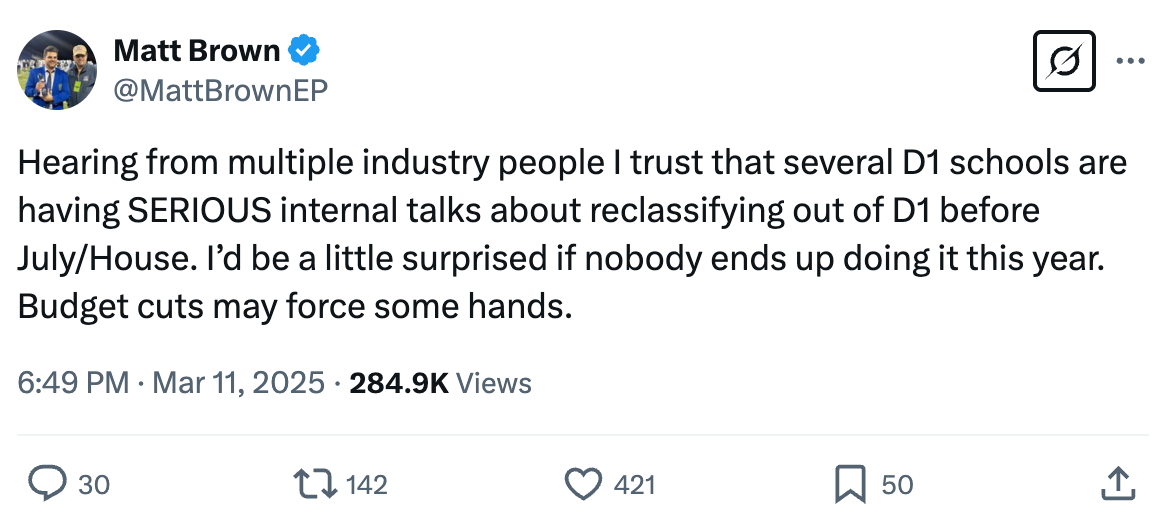
After the Saint Francis (PA) decision, Brown indicated they were one of the schools he was alluding to in his social media post in early March and that he still knew of a few other universities having conversations about potentially leaving Division I.
10,000 FOOT VIEW: CONFERENCE REALIGNMENT
The Saint Francis (PA) move is part of a giant shift in Division I forced by NIL and revenue sharing. These are likely the two most significant changes in NCAA athletics since Title IX. Even though Division II and Division III were not explicitly created as a response to Title IX, they did play a part as colleges and universities either decided to sponsor fewer sports (Division II) or not offer scholarships (Division III) to comply with equal sports and scholarships for each gender.
Because these NCAA Divisions are 50+ years old, they are archaic; if you wanted to break up the 363 schools left playing in Division I men’s basketball, the structure would be more similar to the English football league pyramid.
Here is the English Football League Pyramid….
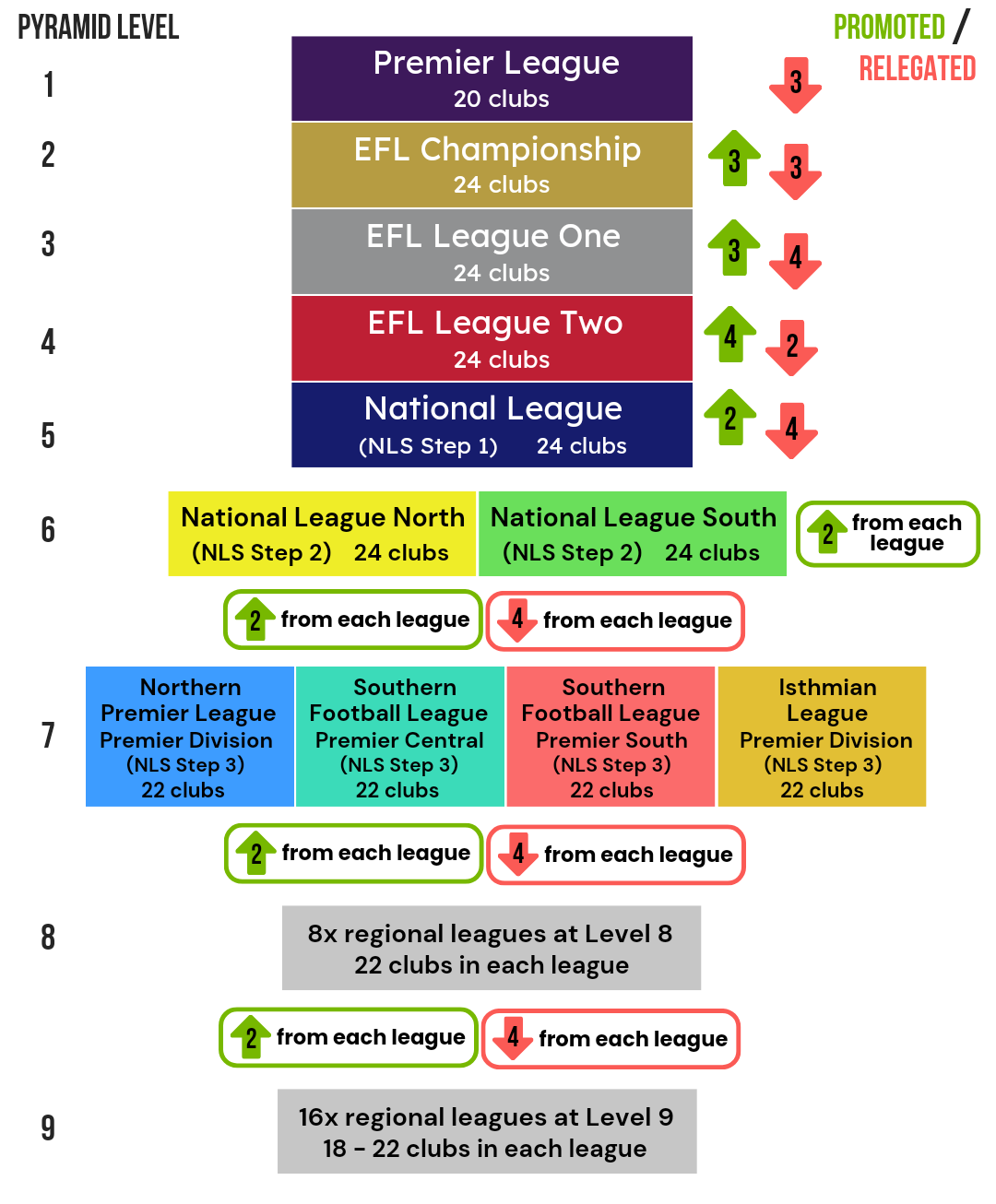
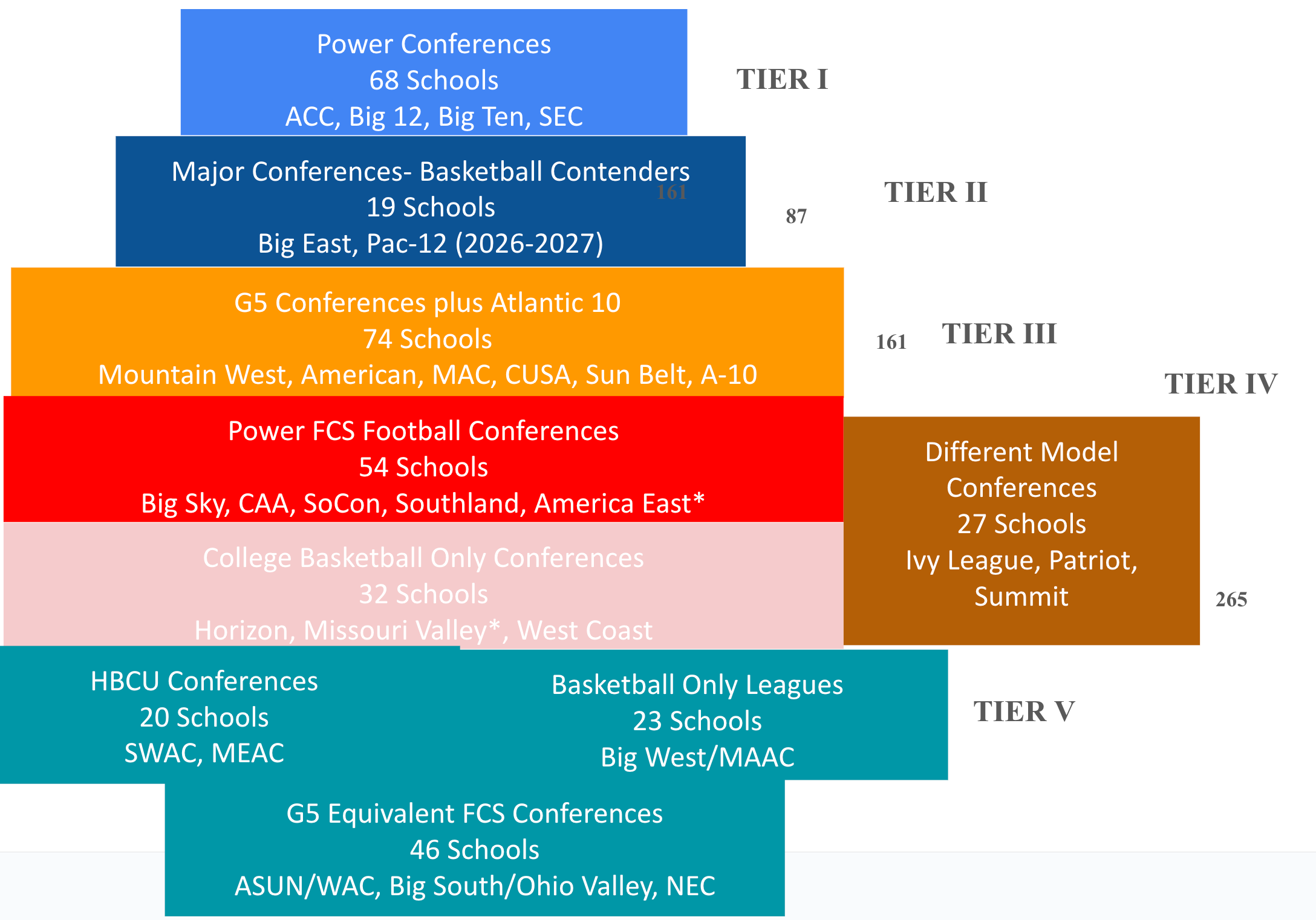
Here is my version of the NCAA Basketball College Pyramid I made, complete with Pyramid Levels and annotated with the number of schools in each level.
This pyramid is driven by college football realignment and greatly influences college basketball.
However, the 90 schools, now 89 colleges and universities in Tier V, should consider whether the Division I models fit their schools or would be better off in Division II or III.
Using this model, I identified about 20% of Tier V schools that could be considering a possible move to DII or DIII, like Saint Francis (PA), or even dropping sports, like Saint Francis (Brooklyn).
I laid out in-depth some of the factors in play in these Tier V conferences, so if a school from one of these conferences not on the list dropped back out of DI tomorrow, I would not be surprised.
NCAA TIER I: POWER CONFERENCES (ACC, Big Ten, SEC, Big 12)
This is currently the Premier League of College Athletics.
Schools in this league will spend the most money on football and college basketball. The goal for each one of these leagues is to have multiple teams in the College Football Playoff and NCAA Tournament, driving up their television rights and, in the case of men’s basketball, picking up more units.
NCAA TIER II: MAJOR CONFERENCES (Big East, Pac-12)
This is the English Championship League.
When the new Pac-12 starts competing in the 2026-2027 season, it should join the Big East as the two conferences that will be the leading outside of the power conferences in getting multiple berths to the NCAA Tournament and having various teams challenge for Final Four runs and national titles.
Given the NIL set-ups and possible revenue-sharing loophole for basketball-focused programs (additional reading: Yahoo’s Ross Dellenger), schools like UConn, St. John’s, Villanova, and Gonzaga should continue challenging for national titles for the decade.
Both these conferences have fizzled as football leagues with power conference status as power conferences, mainly the ACC and the Big Ten (think of it as their best programs were promoted), took historical school brands associated with the conference since their inception.
NCAA TIER III: G5 FBS CONFERENCES AND ATLANTIC 10
These schools are all opting into revenue sharing, and most teams in these conferences have ambitions to play football (FBS) and college basketball (Sweet 16/Final Four runs) at the highest level.
These conferences have had teams that have made the Final Four in the last fifteen years (VCU, Wichita State, Florida Atlantic, Loyola Chicago), and it would not be that far outside the realm of possibly one of these teams from these conferences making a Final Four run again given the right circumstances.
The main thing going for these conferences is they still have some brand names in these conferences, like UNLV, Memphis, and Dayton, not to mention some of these recent Final Four teams.
To go back to the English Football example, League One is where Wrexham currently plays. Much like Wrexham, schools in these conferences continue to get key invites to early-season MTE tournaments or the Players’ Era tournament, which will feature Saint Joseph’s and UNLV next season. Also, up-and-coming brands, like Liberty, Grand Canyon (joining the Mountain West in the 2026-2027 season), or James Madison, have had substantial success in the past decade and might have some financial backing to compete in today’s NIL/revenue-sharing world.
Through Tier III, there are 161 teams, including 133 of 136 in FBS football (Army, Navy, and Northern Illinois are part of these conferences for football, not basketball). 18 of the 161 teams do not have a college football team. 15 of these basketball-focused schools are in the Big East or Atlantic 10, with the other three being Gonzaga, Grand Canyon, and Wichita State.
NCAA TIER IV: Power FCS Conferences, College Basketball Only Conferences, Different Model Conferences
Five leagues (CAA, Big Sky, Southland, SoCon, and America East) have had most of their schools opt into the House Settlement regarding revenue sharing.
For example, the CAA opted in as a league, including its 13 members and four associate members who play CAA football but are members of the America East for basketball.
These conferences are one-bid leagues in basketball, but multiple teams from these conferences usually contend for a spot in the FCS playoffs (Along with the football-only Missouri Valley Football Conference, CAA, and Big Sky are likely the three best conferences in FCS).
Some schools in these conferences, like Sacramento State in the Big Sky, do not hide their desire to be added to the Mountain West or Pac-12 in the next realignment move. So, the best teams in Tier IV are constantly fundraising to be successful and move up to Tier III if given the opportunity.
Horizon, Missouri Valley, and West Coast
22 of the 32 teams currently in these leagues only play college basketball, and conference realignment on the basketball side has hurt these leagues in recent years, as they have gone from multiple-bid leagues in the NCAA Tournament to likely one-bid leagues.
Since 2009, these three conferences have played in 6 Final Fours, but all four schools that made the Final Four (2009, 2010 Butler, 2013 Wichita State, 2017, 2021 Gonzaga, 2018 Loyola Chicago) have since left or plan to leave their conferences moving up to a Tier II or Tier III level conference focused entirely on basketball.
There are still some programs with NCAA Tournament historical success, so there could be a nostalgic second-weekend run for schools like Saint Mary’s, San Francisco, Milwaukee, Drake, or Bradley in the next decade, but it seems unlikely that the schools in these conferences can compete with Big East or A-10 on NIL or revenue-sharing, meaning Final Four runs may be a thing of the past.
Ivy League/Patriot/Summit
These three leagues have unique circumstances that make them Tier IV schools and very stable within the Division I landscape but also in a place where schools and conferences have opted out of the House settlement. The Ivy League was the first conference to opt out and has been trying to bank on their institution's academic prowess to keep athletes for four years.
Patriot has similar schools in their conference prioritizing academics, plus the two service academies, Army and Navy. Their conference membership seems stable, and if anything, if an academic institution like Johns Hopkins ever moves all its sports (not just lacrosse) to Division I, the Patriot League looks to be the logical fit for the Blue Jays.
The Summit League is led by the four Division I Dakota universities that are part of the conference for basketball and members of a football-only FCS conference.
FCS powerhouses North Dakota State and South Dakota State, plus their main rivals North Dakota and South Dakota, opted out of the House settlement right now and seem content right now in FCS (plus, as of now, they don’t have an invitation to any Division I conference at the moment even though they could make geographical sense for Mountain West expansion). The Summit also could be in a position to expand by bringing the Utah schools from the WAC (Southern Utah, Utah Tech) if that league dissolves.
Through Tier IV, there are 274 members of Division I, including all 136 FBS schools, 78 FCS schools (all the teams usually making the quarterfinals and hosting playoff games), 58 schools without a football program, and only a DI basketball program.
TIER V: HBCU Conferences, G5 Equivalent FCS Schools, and Big West/MAAC Basketball Leagues
TIER V IS WHERE YOU FIND THE SCHOOLS THAT COULD BE IN A POSITION TO DROP DOWN TO DII OR DIII
There are 89 schools in these Tier V parts of Division I, in these nine conferences.
Why identified 19 schools from 7 conferences that could be in a position to drop down to DII or DIII it would not surprise me if any of the 89 schools decided to follow St. Francis.
Most of these conferences will send their conference champion to the First Four games as #16 seed and since the field expanded to 68 teams in 2011 these nine leagues have won 17 of the 26 #16 seed vs #16 seed play-in games.
HBCU Conferences (SWAC and MEAC)
Schools to Watch that May Reclassify: Coppin State, Alcorn State, Mississippi Valley State
Division I HBCU schools have been very open about some financial hardships. Mississippi Valley State has been called “The Washington Generals of College Basketball” because it travels from November to January, losing paid games and helping fund the entire school’s athletic department.
In the past 15 years, the MEAC has had two programs (Winston Salem State and Savannah State) reclassify back to Division II due to financial concerns, and there is always a chance current programs in the SWAC or MEAC could follow this precedent. Since 1995, seven schools have moved up from the Division II HBCU conferences (CIAA and SIAC), but just over half of them remain in Division I (Alabama A&M, North Carolina Central, Hampton, Norfolk State).
There is always a public policy threat for HBCUs since most rely on federal and state funding. For example, the three Division I HBCUs (Jackson State, Alcorn State, Mississippi Valley State) that are based in Mississippi, have seen lawmakers unsuccessfully bring up legislation to merge the schools or close some public universities since 2009.
Coppin State (MEAC), Alcorn State (SWAC), and Mississippi Valley State (SWAC) are three schools to watch for reclassification because they have smaller endowments and have publicly disclosed some financial troubles based on student enrollment or funding in the past few years. The wildcard with HBCU schools’ movement out of Division I is federal funding in Washington, where the Trump administration is looking to cut from the Department of Agriculture and Department of Education that could affect HBCU’s schools but also spent a lot of their first administration touting more federal funding for HBCU schools.
OVC/ASUN/Big South/NEC/WAC
Schools to Watch that May Reclassify: Jacksonville, Stetson, Charleston Southern, Gardner-Webb, SIUE, Tennessee State
Only about half of the schools in these conferences play football, yet all their leagues currently sponsor FCS football in some form (ASUN/WAC and OVC/Big South have merged in football in order to keep their automatic bid to FCS playoffs)
These conferences have been sustained in recent years by adding Division II teams. With the current financial uncertainty around college sports in the NIL and the revenue-sharing era, Division II teams may not move up until things stabilize.
These five leagues are where private schools like Saint Francis (PA) might be more suited to DII or DIII.
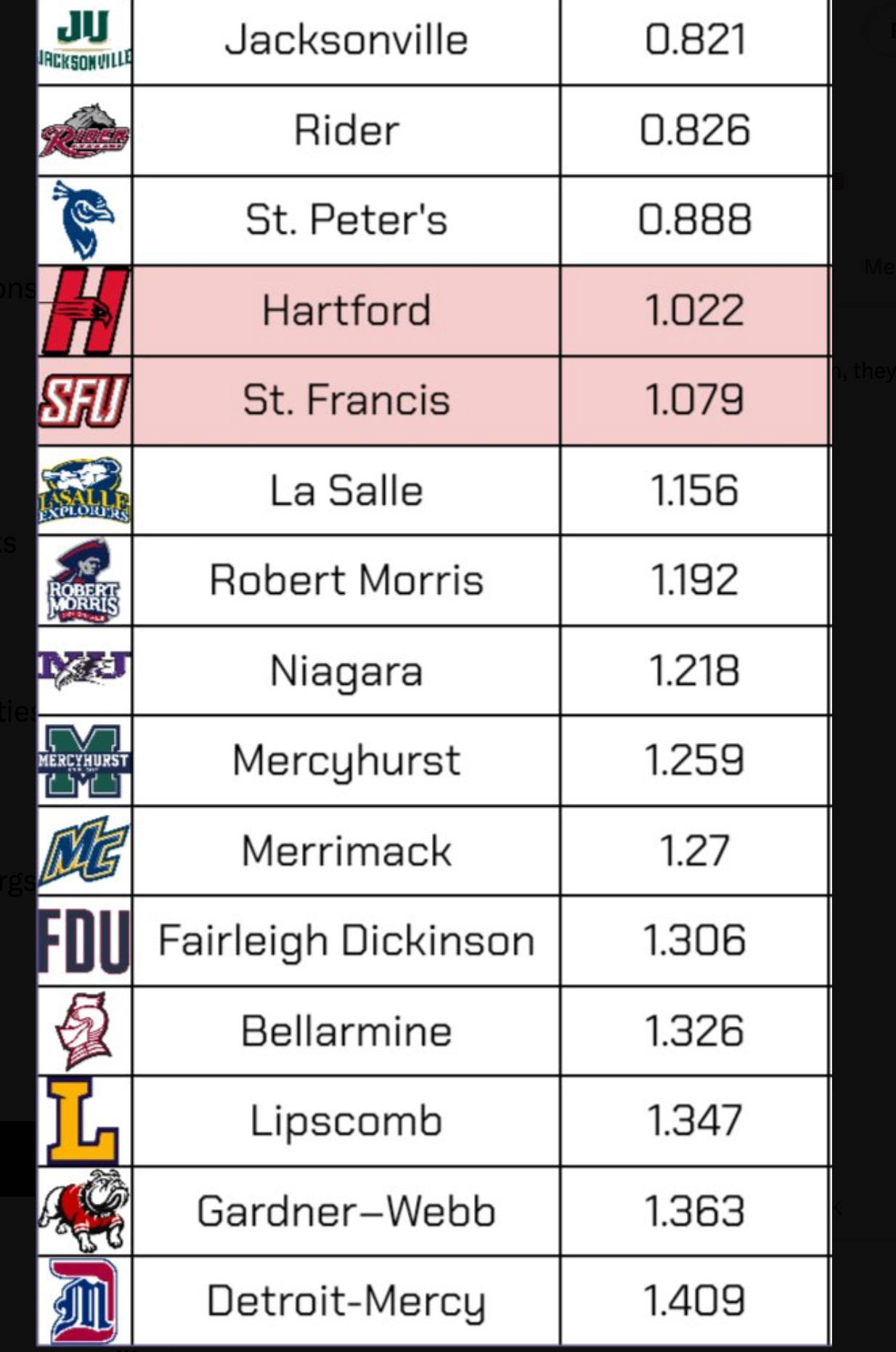
ASUN: Jacksonville and Stetson might fit better as members of the DII Sunshine State Conference, along with Barry and Rollins, other private Florida schools. Jacksonville is listed as having the lowest financial grade out of any Division I school according to Forbes (full list below).
Big South: In the Big South, the two programs with scholarship football teams are private universities. Charleston Southern has the smallest endowment and a scholarship football team. Forbes also lists Gardner-Webb as one of the most financially unstable colleges in North Carolina and the it too has a scholarship football program. Flashback to Birmingham Southern, which was a Big South member from 2000 to 2007 before returning to Division III1. It would not be surprising if one of the four private schools in the Big South, especially Charleston Southern or Gardner-Webb, decided to move down to DIII.
OVC: OVC only has one private school, new Division I member, Lindenwood, but do have some public universities with financial troubles. SIUE, coming off their first-ever men’s NCAA Tournament appearance, is in the middle of layoffs and academic program cuts to address the school’s $10.3 million deficit. Tennessee State is coming off its first-ever-at-large berth to the FCS playoffs in 2024, led by NFL Hall of Famer Eddie George (who has since taken the Bowling Green job), and is facing various financial headaches. Tennessee State’s interim president said the school may run out of cash in April or May, and the HBCU university based in Nashville said it is losing $14.4M in federal grant funding because of cuts by the Trump administration.
NEC: Only four members have been members for more than five years (FDU, LIU, Wagner, CCSU), and three of the four new members include three schools (Stonehill, Le Moyne, and Mercyhurst) transitioning to DI. Per Matt Brown, the NEC movement should be done for now, but there might not be many more northeast Division II universities looking to move up right now after having four schools moved up in the last five years. Two Division II schools that would make sense geographically to move up to Division I (and have previously mentioned them), New Haven and Gannon (Erie, PA), were cited by Forbes for having failing financial grades, likely complicating any move to the NEC.
WAC: Private school Cal Baptist announced plans to join the Big West. The WAC will have only six members in 2026-2027 and will lose its automatic bid to the NCAA Tournament if it goes under six members.
As mentioned above, it has been reported that the Utah schools (Southern Utah, Utah Tech) will head to the Summit, and Utah Valley may join Cal Baptist and head to the Big West, while the three Texas schools (Abilene Christian, Tarleton State, UT Arlington) will head to the ASUN (where two of them play football in a combined league) or to the Southland. It seems inevitable that the WAC may cease to exist by the 2026-2027 academic calendar; their only lifeline may be expansion with DII schools from Utah, Colorado, or Texas, some of which compete in other Division I sports2.
MAAC/Big West
Schools to Watch that May Reclassify: CS Bakersfield, Long Beach State, CS Fullerton, Rider, St. Peter’s, Niagara, Merrimack, Canisius
The Big West and MAAC are made up of twenty-three schools. These two leagues share a complicated history. Both failed as football conferences3, and they face financial troubles due to factors that specifically relate to the schools that make up their leagues.
In the Big West, Cal Baptist became just the second private school to join the Big West (Pacific was a member from 1971-2013), and every other school in the Big West is a member of the California public education system. Six of the ten Big West schools have moved up to Division I since 1996, including five universities that are members of the California state system. However, prioritizing athletics in the face of budget cuts as Division II Sonoma State recently announced plans to end its athletic program. Cal State Bakersfield is facing a budget shortfall, a projected $17.8 million next year; at the same time, the Governor of California has proposed this $375 million budget cut to the California State University System that includes Cal State Bakersfield and four other Big West schools (Long Beach State, CS Fullerton, CSUN, Cal Poly).
In the MAAC, 21 Catholic colleges and universities have closed since 2016, and 10 of 13 private schools in the MAAC are Catholic universities. Donna Carroll, the executive director of the Association of Catholic Colleges and Universities, on the closures: “Catholic colleges and universities are not immune to the challenges facing higher education, in general, and the number of closings reflects that — no more, no less, the fact that so many of our Catholic colleges and universities are small by design is both a strength and a vulnerability; it often equates with tight margins.”
As SwordishCFH pointed out on X, if you take Forbes' 2024 report on the financial health of U.S. universities4 and overlap it with Division I programs, you would see Hartford and Saint Francis (PA) in the bottom ten. This list shows four MAAC members (Rider, St. Peter’s, Niagara, Merrimack) even though it was published after St. Peter’s 2022 Elite Eight run, where they saw an enrollment bump in the following academic year. The good news is the MAAC has negotiated a new basketball deal with ESPN, but the bad news could be reading the tea leaves a school like Canisius has decided to opt out of the House settlement, which could be a harbinger that that school might be looking to leave Division I.
.
Birmingham Southern would close following the 2023-2024 academic year.
Westminster College (Salt Lake City, Utah) competes at the highest level of NCAA Skiing and is a Division II in other sports. Dallas Baptist competes in NCAA DI baseball (Conference USA) and just made the Final Four in DII basketball. Colorado has ten DII schools, and schools like Metro State and other Colorado schools were contacted by the WAC in 2018. Schools like Westminster, Dallas Baptist, and Metro State would not need to add sports to move up. https://www.cpr.org/2018/10/30/after-35-years-as-top-division-ii-contenders-metro-state-considers-division-i/
Big West Football disbanded after the 2000 season, and MAAC Football dissolved after 2007.
Nice blog here of the most at-risk colleges by region. Forbes locked their article, but this explains a lot about how they figured out the financial health of a university. https://deepthoughtshed.com/2024/12/29/colleges-most-likely-to-close-based-on-2024-forbes-financial-health-failing-grades/